I've Watched Organizations Fail the Same Cyber Drill for a Decade
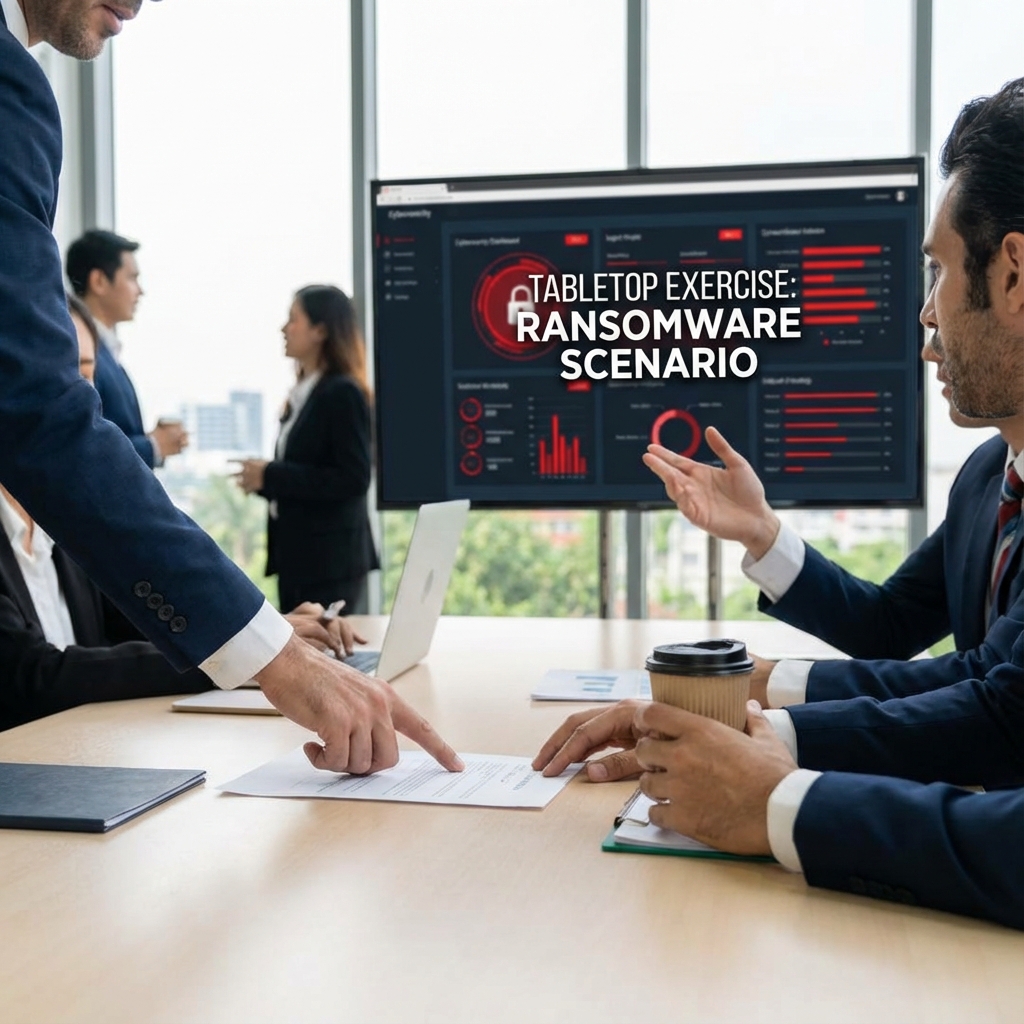
I've facilitated cybersecurity tabletop exercises for retail chains, SaaS platforms, and multi-location service companies. The pattern is consistent.
The CISO presents a ransomware scenario. Operations freezes. Legal argues with IT about notification timelines. The CEO asks questions that should have been answered in the first five minutes.
Everyone discovers they've never practiced this conversation before.
When IBM measured breach costs in 2024, organizations with tested incident response plans saved $1.49 million compared to those without. That number reflects something simple: practice reduces panic.
Tabletop exercises are not compliance theater. They expose decision gaps before money starts leaving your account.
Most Organizations Practice the Wrong Things
I see three failure patterns in how companies approach cyber readiness.
First, they run technical drills without business context. The security team practices restoring backups. Finance, legal, and communications sit on the sidelines. When a real incident hits, those groups make decisions that cost more than the breach itself.
Second, they treat tabletop exercises as a checklist item. Annual compliance requirement. Check the box. Move on. The exercise becomes a performance instead of a learning moment.
Third, they avoid the uncomfortable scenarios. No one wants to simulate the board call where you explain why customer data leaked. So they practice password resets instead of crisis decisions.
The result? Organizations respond to cyber incidents 40% slower than those who practice realistic scenarios regularly.
What Actually Happens During a Breach
Ransomware incidents cost organizations an average of $5.08 million in 2025, even when they don't pay the ransom. That cost comes from three sources: downtime, recovery work, and bad decisions made under pressure.
I've watched leadership teams debate whether to notify customers while systems stay offline. I've seen legal counsel discover mid-incident that their cyber insurance policy requires notification within 24 hours. I've watched CEOs realize they don't know which systems hold regulated data.
These are not technical problems. They are coordination and decision problems that tabletop exercises solve in peacetime.
CISA's guidance is direct: the goal of tabletop exercises is not perfect performance. The goal is to work out problem areas when the stakes are zero.
The Questions You Can't Answer During a Real Incident
Here's what gets exposed in a well-designed tabletop:
Who decides whether to take systems offline? Operations wants uptime. Security wants containment. Finance wants to understand the cost. If you've never had this conversation, the first time will be during an active breach.
How long does it take to gather the information executives need? You need a list of affected systems, customer impact, regulatory exposure, and recovery options. If that takes six hours to compile, your response timeline just doubled.
Who talks to customers, regulators, and the press? I've seen marketing send an email before legal reviewed it. I've seen CEOs promise timelines that engineering couldn't meet. Clear communication protocols prevent these mistakes.
What does recovery actually cost? Not just the ransom or the forensics bill. Overtime, lost revenue, customer churn, regulatory fines. If your CFO doesn't have a framework for calculating breach costs, your insurance claim will be a mess.
Tabletop exercises surface these questions before they become expensive mistakes.
How to Run a Tabletop That Actually Prepares You
I've run tabletop exercises for boards, executive teams, and cross-functional response groups. The effective ones follow a pattern.
Start With a Realistic Scenario
Pick a threat that matches your business model and risk profile. Retail companies should practice point-of-sale compromises. SaaS platforms should practice account takeovers and data exfiltration. Multi-location service businesses should practice operational technology failures.
Make it specific. "A ransomware attack" is too vague. "Ransomware encrypted your customer database and order management system at 6am on Black Friday" creates urgency and forces trade-offs.
Include the Right People
Technical teams cannot run incident response alone. You need:
Executive leadership to make business continuity decisions
Legal counsel to navigate notification requirements and liability
Finance to track costs and manage insurance claims
Communications to handle customer, employee, and public messaging
Operations to assess business impact and recovery priorities
IT and security to provide technical options and constraints
If someone would be in the room during a real incident, they should be in the tabletop.
Focus on Decisions, Not Technical Steps
The exercise should force choices under time pressure. Do you restore from backups or rebuild systems? Do you notify customers immediately or wait until you understand the scope? Do you engage law enforcement?
Each decision has trade-offs. The tabletop should expose those trade-offs and reveal where your team lacks information or alignment.
Measure What Matters
Track three things:
Decision speed. How long does it take to choose a course of action? Delays compound. If it takes 90 minutes to decide whether to take systems offline, the breach spreads for 90 minutes.
Information gaps. What questions can't you answer? Missing data, unclear roles, and unknown dependencies all slow response.
Coordination breakdowns. Where do teams talk past each other? Where do priorities conflict? These friction points will be worse during a real incident.
Document and Fix the Gaps
The value of a tabletop comes after the exercise ends. You should leave with a list of specific improvements:
Update the incident response plan to reflect actual decision-makers
Create communication templates for common scenarios
Clarify roles and escalation paths
Identify missing tools or access controls
Schedule follow-up training for weak areas
If you don't fix the gaps, you'll fail the same drill next year.
The Scenarios Worth Practicing in 2026
Cyber threats evolve. Your tabletop scenarios should reflect current risks.
Ransomware with data exfiltration. Attackers now steal data before encrypting systems. You face two problems: restore operations and prevent data publication. This scenario forces conversations about ransom payment, customer notification, and regulatory exposure.
Cloud service compromise. 82% of breaches in 2023 involved data stored in the cloud. Practice scenarios where your SaaS provider suffers a breach or your cloud infrastructure gets misconfigured. Who owns the response? What data is at risk?
Supply chain attacks. Your vendors and partners can access your systems. Practice a scenario where a third-party compromise gives attackers access to your network. This reveals gaps in third-party risk management and access controls.
AI-related incidents. CISA ran the federal government's first AI cybersecurity tabletop in 2024. Practice scenarios where AI systems are manipulated, poisoned, or used to generate convincing phishing attacks.
Insider threats. Not all incidents come from external attackers. Practice scenarios where an employee with legitimate access misuses data or sabotages systems. This tests monitoring, access controls, and HR coordination.
What Boards Should Demand
If you sit on a board or advise executive leadership, ask three questions about cyber readiness:
When did we last run a tabletop exercise that included executive leadership? If the answer is "never" or "more than a year ago," you're unprepared.
What did we learn from the last exercise, and what did we fix? Tabletop exercises without follow-through are wasted time. You should see documented improvements to plans, tools, and processes.
How long would it take us to make critical decisions during an incident? If leadership doesn't know who decides whether to pay a ransom, how to calculate breach costs, or when to notify regulators, you'll make expensive mistakes under pressure.
The organizations that recover fastest from cyber incidents are the ones that practiced the hard conversations before the crisis started.
Why Most Tabletops Fail
I've seen tabletop exercises fail in predictable ways.
They're too easy. The scenario doesn't create real pressure. No time constraints. No conflicting priorities. No missing information. The team talks through a sanitized version of an incident and learns nothing.
They're too technical. The exercise focuses on technical response steps instead of business decisions. IT walks through backup restoration while executives check email.
They lack consequences. Participants make decisions without understanding the trade-offs. No one calculates the cost of downtime or the risk of regulatory fines. Decisions feel abstract.
They don't surface conflict. Real incidents create tension between teams with different priorities. If your tabletop doesn't expose those tensions, you're not practicing the hard parts.
A well-designed tabletop should feel uncomfortable. You should discover gaps, conflicts, and missing information. That discomfort is the point.
The ROI of Practice
Organizations that regularly conduct tabletop exercises respond to incidents 40% faster and recover 30% more cost-effectively than those that don't. That translates to millions in avoided losses.
But the value goes beyond speed and cost. Tabletop exercises build muscle memory for crisis decisions. They reveal weak points in your response plan. They align teams around shared priorities.
When a real incident happens, you'll still face pressure and uncertainty. But you won't be making up your response process in real time.
What I've Learned From Facilitating These Exercises
I've run tabletop exercises for companies with mature security programs and companies with no incident response plan at all. The pattern is consistent.
The companies that practice regularly recover faster. They know who makes decisions. They have communication templates ready. They've debugged their coordination problems.
The companies that avoid practice pay more. They waste time arguing about roles. They make decisions without understanding the trade-offs. They discover gaps in their insurance coverage mid-incident.
Tabletop exercises are not exciting. They don't generate immediate revenue. But they prevent expensive mistakes when the stakes are real.
If you haven't run a tabletop exercise in the last year, you're not prepared for the incident that's coming. And if cybercrime costs are projected to hit $10.5 trillion annually by 2026, the question is not whether you'll face an incident.
The question is whether you'll know what to do when it happens.
Start With One Exercise
You don't need a perfect incident response plan to run your first tabletop. You need a realistic scenario, the right people in the room, and a facilitator who asks hard questions.
Pick a scenario that matches your biggest risk. Ransomware for most companies. Cloud compromise if you're SaaS-heavy. Supply chain attack if you rely on third-party integrations.
Invite decision-makers from across the business. Set aside two hours. Walk through the scenario and force choices.
You'll discover gaps. Document them. Fix them. Run another exercise in six months.
The companies that survive cyber incidents are the ones that practiced before the crisis started.
I've watched organizations lose millions because they waited until the breach to figure out their response process. Don't be one of them.
Comments
Post a Comment